
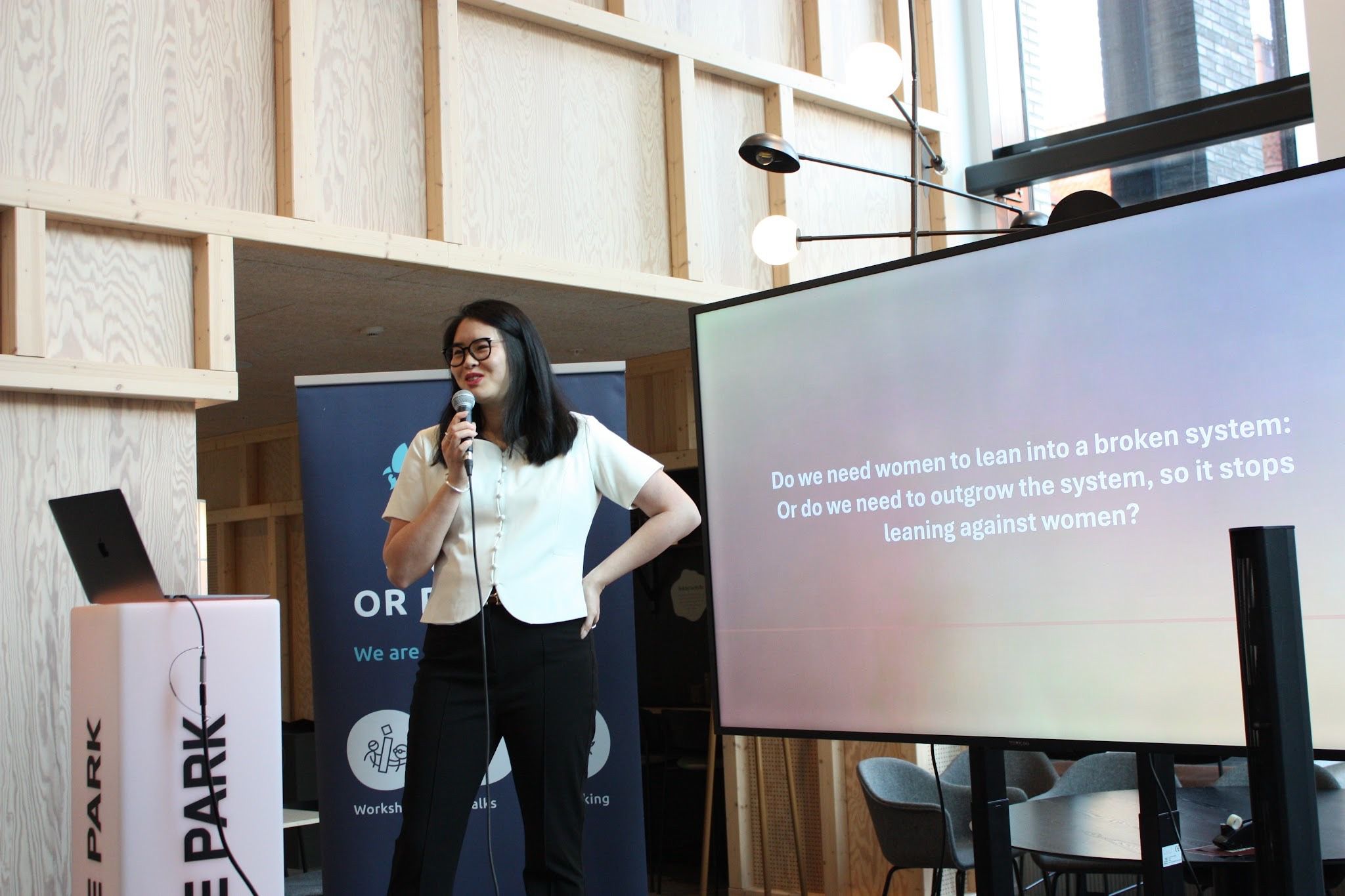
On Monday, March 30th, at Science Park, women in business and leadership were put at the forefront. SartUp and Edit organised the event Women to the front. With speeches, a panel discussion and a workshop, students gathered to reflect on ambition, confidence, and what it means to lead, especially as a woman.
“sorority” “inspiration” “opportunity “necessary” “important” “equality” “empowering” “motivational” “courage”
These are some of the words that students used to describe female leadership. “I feel that we are all looking to be inspired” explains Natalia, a student in global studies. “As women, we stay together. I think a topic impacts more when a woman is talking to a woman.” For her, “everything is an opportunity, independently from gender, but the fact that we are working or wanting to develop this topic more is an opportunity to move forwards, to be more involved”. Rokas feels that “even as a man looking at a woman in power is really motivational for me to succeed”.
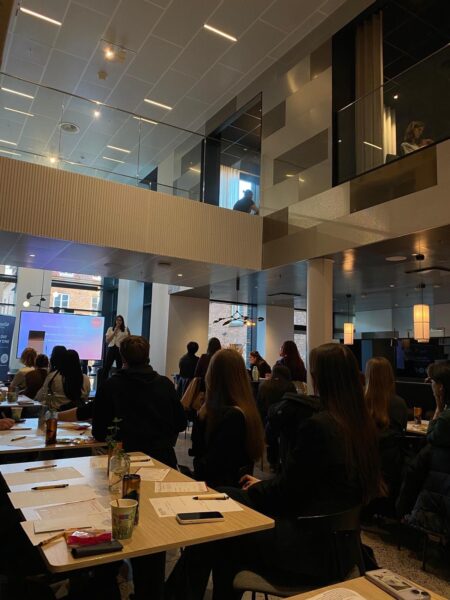
Beyond being inspirational, the event challenged students to rethink leadership—not as a distant practice, but as something many may already embody. The first speech of the day was given by Helén Truong, a global product manager at Securitas Group, who included the crowd in her reflection by calling us her “team”. One of the skills she shared was “get you a mentor, make sure you also get you the sponsorship”, because “When we look at male and female, we do not lack ambition, we lack support”, she explained, emphasizing the importance of mentorship and sponsorship. HSBC report released on the 12th of March found that “Women are supposed to control 40% of global wealth by 2030” However, the survey found that “just one-third (32%) of affluent women said they feel prepared for their own long-term care needs. Less than half said they feel supported by their financial advisor or financial institution. At the same time, nearly two-thirds said they plan financially for others, not just themselves, and 43% said leaving financial security to loved ones is a priority.”
Another important skill the JU alumni put forward: asking the right questions is more valuable than knowing the answers. “I like to tell my team, in the era of AI, everybody can know the answer pretty quickly. Now it is no longer a goal. As a project manager, instead of asking “how do I build a fast car” you should probably ask “why do we need a fast car”. A person that is very good at asking questions uncovers value while the person that just knows it all has an end destination.”. Digital life is also very important to handle. “In the era of social media, if it is your private life, lock it down, because researchers will find it. If it is for the public, make this a strategy. Everything you put on Linkedin, everything you write, or online discussions should be part of your strategy. I have had specific Linkedin recruiters who have helped me find candidates.”
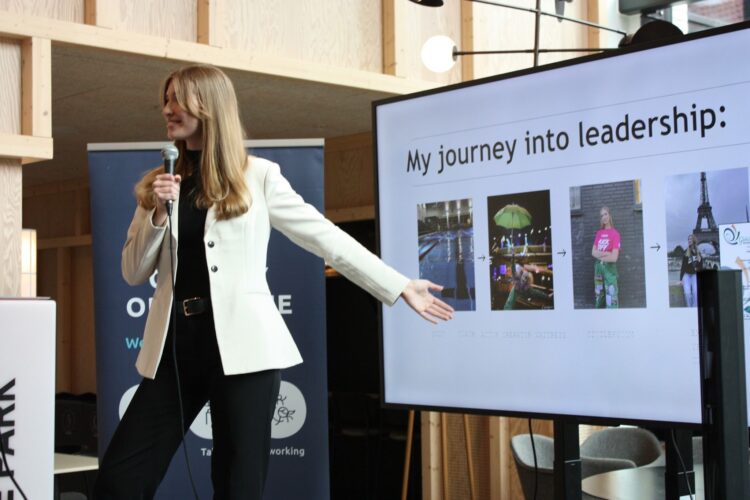
Building on this, Tindra Richards, head of Projects and Talents at LARS made students realize they probably are already leaders without realizing it. “Do people often come to you for help? Do you consider yourself to be a good listener? Do you often see solutions where others don’t?” When the enthusiastic and energetic alumni asked the audience these questions, most of the crowd – mostly women, but also men – raised their hands. To their own surprise, lots of students just discovered they also have leadership skills. “It is hard to call yourself a leader” she acknowledges. “However, when your friends tell you that you inspired them to try or that they trust you, it is because they see these skills in you.”
The two talks resonated with many students. For Josephine, “one part that resonated with me the most was Helén having, as she described it herself, a very cutthroat personality. When everyone is kind of new to working together in a university environment that can be taken as more negative sometimes, but it is really not. Sometimes I can seem very stern in the way I describe things I advise, but it is really coming from a “I want to help” perspective rather than “this is a personal attack”.
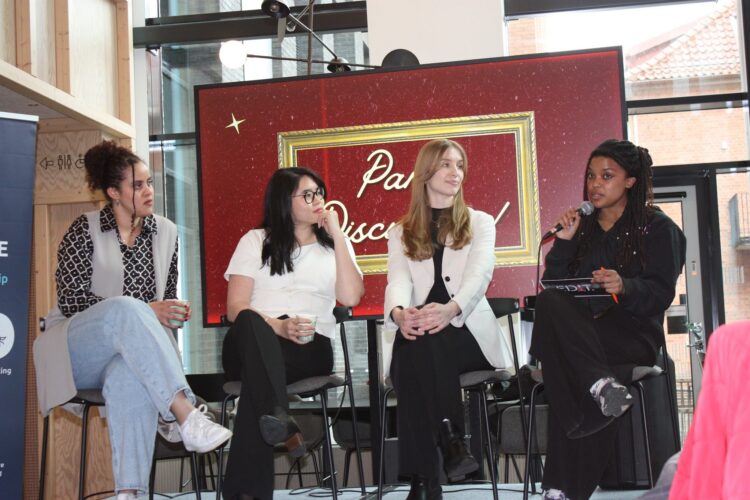
After the two speeches and the panel discussion, students queued, sometimes for quite some minutes, to get precious advice from the guests of the day, whether it be on a project they are currently working on, or how to improve Linkedin profiles.
When my turn came, I asked the 3 lecturers what message they feel students most need to hear at the moment. Helén Truong finds “it troublesome the amount of people trying to figure out what they want, what they need to do because it kind of limits a person’s mindset to explore, and when you don’t dare to explore, you don’t dare to fail”. Following that, Tindra Richards reminds us that “you don’t have to have a straight line, please do some curves, up and down”.
“Please do us a favor and stop going into Linkedin and comparing yourself!” asks Lamiaa Bakry, a PhD candidate and a researcher in Buisness Administration “stop comparing, try as many times as possible, fail as many times as possible, it is really nice to fail at the beginning. This will enable you “to figure out what you want instead of going after what you think you want.”
One thing that shaped Helén Truong as a student was learning “how to reach out and shape or create a relationship with someone else. It will last you for life, even in the corporate world.” Lamiaa Bakery adds to this that “when you work in real life, you don’t get to choose your team, most of the time. So get yourself comfortable with working with people that are not your choice.”
Writer: Amy Vilette
Photography: Christine Yin